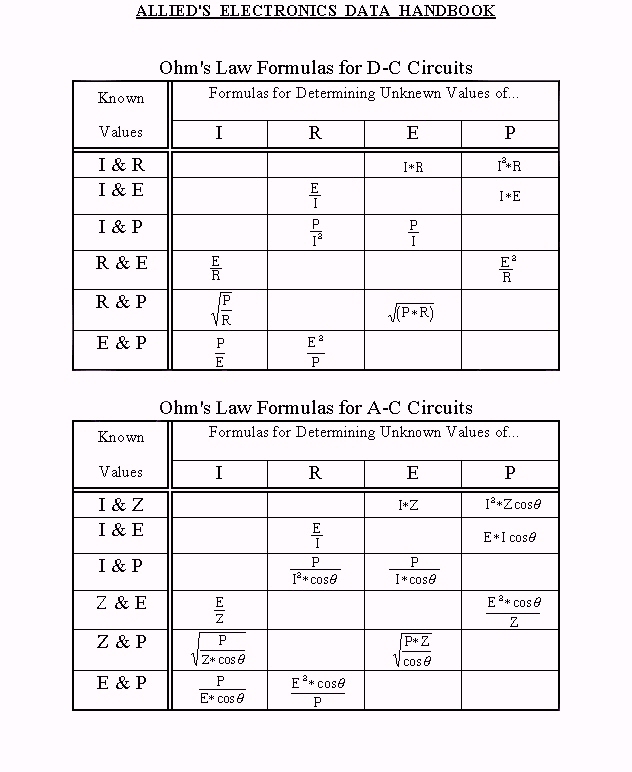
| The fundamental Ohm’s law formulas for a-c circuits are given by: |
||||
| I = E / Z | Z = E / I | |||
| E = I*Z | P = E*I*cos Ø | |||
| Where: | I = current in amperes, | |||
| Z = impedance in Ohms, | ||||
| E = volts across, | ||||
| P = power in watts, | ||||
| Ø = phase angle in degrees. | ||||
| Phase Angle | ||||
| The phase angle is defined as the difference | ||||
| in degrees by which current leads voltage in a | ||||
| capacitive circuit, or lags voltage in an inductive | ||||
| circuit, and in series circuits is equal to the | ||||
| angle whose tangent is given by the ratio X/R and | ||||
| is expressed by: | ||||
| arc tan (X/R) | ||||
| Where: | ||||
| X = the inductive or capacitive reactance in ohms, | ||||
| R = the non-reactive resistance in ohms, | ||||
| of the combined resistive and reactive components | ||||
| of the circuit under consideration. | ||||
| Therefore: | ||||
| in a purely resistive circuit, Ø = 0° | ||||
| in a purely reactive circuit, Ø = 90° | ||||
| and in a resonant. circuit, Ø = 0° | ||||
| also when: | ||||
| Ø = 0°, cos Ø = l and P = E*I, | ||||
| Ø = 90°, cos Ø = 0 and P = 0. | ||||
| ————– | ||||
| Degrees x 0.0175 = radians. 1 radian = 57.3° |
||||
| Power Factor | ||||||||
| The power-factor of any a-c circuit is equal to the true power in watts divided by the apparent power in volt-amperes which is equal to the cosine of the phase angle, and is expressed by |
||||||||
| E*I*cos Ø p . f . = —————- = cos Ø E*I |
||||||||
| Where: | ||||||||
| p.f. = the circuit load power factor, | ||||||||
| E*I*cos Ø = the true power in watts, | ||||||||
| E*I* = the apparent power in voltamperes, | ||||||||
| E = the applied potential in volts | ||||||||
| I = load current in amperes. | ||||||||
| Therefore: | ||||||||
| in a purely resistive circuit. | ||||||||
| Ø = 0° and p.f. = 1 | ||||||||
| and in a reactive circuit, | ||||||||
| Ø = 90° and p.f. = 0 | ||||||||
| and in a resonant circuit, | ||||||||
| Ø = 0° and p.f. = 1 | ||||||||
| Ohm’s Law for D-C Circuits | ||||||||
| The fundamental Ohm’s law formulas for | ||||||||
| d-c circuits are given by, | ||||||||
E
R |
E
I |
|||||||
| E = I*R | P = I*E | |||||||
| where: | ||||||||
| I = current in Amperes, | ||||||||
| R = resistance in ohms, | ||||||||
| E = potential across R in volts, | ||||||||
| P = power in watts. | ||||||||